Blame New Zealand’s isolation, which began about 100 million years
ago when the island nation drifted off from a supercontinent known as
Gondwanaland. Surrounded by thousands of miles of sea, New Zealand
evolved its own set of flora and fauna, a Garden of Eden that leaves
visitors speechless when it comes to attempting to describe its
incredible geographical and botanical diversity.
“Brazil meets Switzerland!,” overheard on my November 2011 visit, was
an attempt that struck me as hitting close to the mark.
In 2004, a design team of six talented New Zealanders set themselves
the task of putting — in a nutshell — this botanical bounty as it
related to the country’s indigenous Polynesian people, the Maori.
Intrinsic to Maori belief is that plants and people share a common
ancestry and that it is up to the people to be guardians of nature, the
treasures of the land.
The nutshell turned out to be an entry in the 2004 Chelsea Flower
Show. Held in London since 1862, the show is the most famous flower show
in the United Kingdom, attracting visitors from all over the world. New
Zealand’s entry won a gold medal.
Most Chelsea exhibits are dismantled, never to be seen again. Not so,
New Zealand’s, which brought me to a small museum overlooking pristine
Lake Taupo in the center of New Zealand’s North Island, where the
Chelsea gold-medal winner has been re-created as a permanent exhibit.
“It’s a challenge,” garden caretaker Joanna (Jody) Martin told me as
she pulled off her gardening gloves as we met in the courtyard of the
Taupo Museum, where the Chelsea garden is now located.
“The garden was created to last for the days of the exhibition. Here,
it is an ongoing garden. Over time, plants grow, plants die, requiring
trimming, removal, replacement to keep the garden’s appearance as fresh
as it was at the Chelsea show. My job is to keep it looking perfect.”
As an example, Jody pointed out a cabbage tree, as Cordyline
australis is commonly known, that has towered to twice its
originally planted size. “It’s grown out of proportion to its setting
and has to be replaced with a younger one,” she said.
Every plant in the Chelsea garden, and as re-created in Taupo, was
chosen for its medicinal, culinary or cultural properties. All were
native to New Zealand, with most coming from the central area of the
North Island.
While most perennials flew direct, other plants found it a long
journey to the UK’s shores. Tree ferns stopped off in Ireland for a stay
with a master fern grower to adjust after six weeks at sea.
“It was nervously precision timed,” Jody said. “The ferns didn’t have
fronds up to a week before the show.”
With uncurling fronds internationally recognized as the national
symbol of New Zealand, having no fronds would have been a sad affair for
the garden’s designers. As it was, the garden emerged in hues of lush
green, creating a tropical feel with no evidence of jet lag or culture
shock.
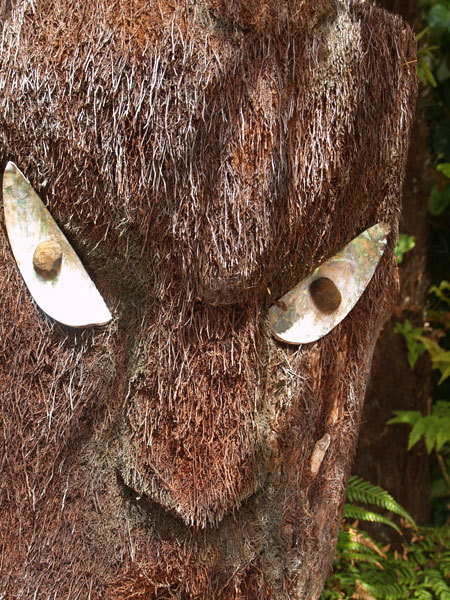
In Chelsea, viewers were encouraged not to step past hand-plaited
flax ropes held in place by four bronze guardian figures representing
the four winds: east, west, north, south.
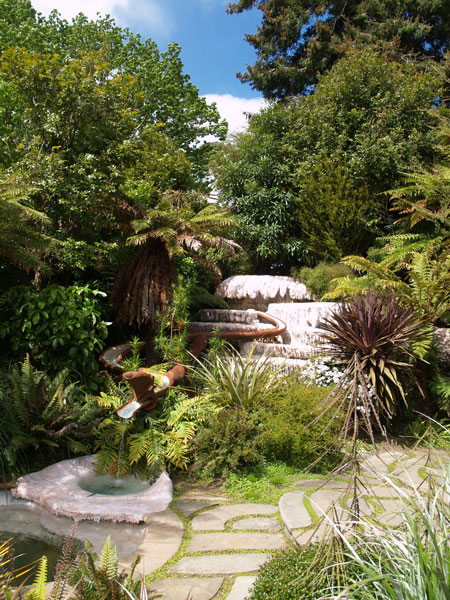
In Taupo, visitors are free to wander into the Hui Marae, or “meeting
place where people gather,” a secluded, sandstone-paved circle. Steps
away is the stream emerging from the mouth of the huge Moko Waiwera, or
hot-water lizard, its wood-carved, curving body extending from a top
pool and across terraces to transport water into a bottom pool.
The terraces, made by Richard Taylor, winner of four Oscars for
special effects, makeup and costume design in the “Lord of the Rings”
film trilogy, are a replica of New Zealand’s famed Pink and White
Terraces. In the 19th century, intrepid Victorian tourists flocked to
New Zealand to bathe in the thermal waters flowing over the silica
terraces, which were known as the “eighth natural wonder of the world”
until destroyed in an 1886 volcanic eruption.
As Jody and I talked, a small boy ran into the garden and immediately
made his way to Te Waha O Ruamoko, “the mouth of the god of the
underworld,” to peer into the cave representing the opening to a
passageway for spirits to enter the underworld domain of Ruamoko, god of
volcanoes and earthquakes.
“It’s the rare child who doesn’t make a beeline to take a look,” Jody
laughed.
While structural features are the “bones” of the garden, plants are
its stars. Nearly 1,000 plants are represented in the small space.
Green is represented in the full range of its spectrum, with vast
variation in foliage — from bold, sword-like leaves to delicate stems
decorated in green lace — creating eye-catching interest. Color emerges
sparingly, with the red-blotched leaves of a pepper tree shrub, hebes’
fluffy flowers, the blue of Chatham Island forget-me-nots… .
Piped-in birdsong and the haunting sound of a Maori flute enhances
the illusion of an idyllic sanctuary in the New Zealand bush.
When the exhibit won its Chelsea gold award, New Zealand gardeners
sat up and took stock of what was growing naturally around them,
realizing that a garden doesn’t have to be filled with European
flowering varieties to be beautiful.
Jody Martin pulled her work gloves back on.
“I love this garden,” she said. “In a tiny space, it showcases what
we have here so beautifully.”
The Ora Garden of Wellbeing (ora is Maori for “well being,”
hence the traditional Maori greeting “Kia ora” literally means
“Be well”) is located in the courtyard of the Taupo Museum (4 Story Place,
Taupo, New Zealand; phone +64 7 376-0414.
The museum, itself, is well worth visiting and includes a fine
replica of a Maori meeting house. It’s open 10 a.m.-4:30 p.m. every day.
Entry costs NZD8 (near $6) for adults or NZD3 for senior citizens or
students, with small children admitted free.

Tidak ada komentar:
Posting Komentar